


🎧 Listen to Tanya read this essay (or stream on Spotify / Apple Podcasts)
When I boarded a plane back to Canada a little over a month ago with my partner and our two cats, after two decades living abroad across Australia and Europe, I knew I wasn’t simply moving home. Returning after twenty years was never going to feel like going back. Somewhere underneath all of the practical decisions and logistical planning, I had the sense that I was once again stepping into one of life’s oldest developmental processes: beginning again.
There’s something quite paradoxical about returning. It asks us to hold beginnings and endings at the same time. We step towards something familiar while discovering that we can never return as the person who once left.
Looking back, I think transition has been one of the oldest teachers in my life. Before I understood what it meant to outgrow one chapter, life was already asking me to begin another. Over the years, I’ve watched that same developmental process unfold again and again in the lives of my clients, even when their circumstances looked completely different. Over and over, I found myself returning to the same questions:
What actually happens when we outgrow a chapter of our lives?
What asks us to leave?
Why is it so difficult to trust ourselves when we do?
Why does grief arrive before relief?
Why does the beginning of something right for us often feel so uncertain?
The more I’ve sat with those questions, the more I’ve come to believe that, despite how different our lives may look, beginning again follows a surprisingly consistent developmental sequence. The process often starts long before we ever leave, with what first feels like an inner knowing that something has come to an end. That recognition confronts us with the loss of what genuinely mattered, while asking us to patiently shape a new reality that, for a long time, bears little resemblance to the life we first imagined. Perhaps the greatest challenge of all is trusting that process long enough for reality to catch up with vision.

Part I: Outgrowing the Container
When a life no longer fits.
There comes a point for many of us when a life that once served us no longer quite does. It might be a home, a relationship, a career, a country, or even an identity we have carried for years. The environment may still feel familiar, supportive, and full of people we genuinely care about. And yet, something begins to feel slightly off.
It’s tempting to dismiss the feeling, to tell ourselves we simply need a holiday, a new routine, or a better attitude. But those solutions rarely reach the heart of what we’re experiencing. Before we can explain it intellectually, the body often begins responding to something the mind has not yet been willing to acknowledge.
We find ourselves dragging through the day, forcing our way through responsibilities that once came naturally. More and more of our energy goes into overriding a growing resistance we can’t yet explain, until we begin wondering whether the problem is us. Maybe we’re depressed. Maybe we’re anxious. Maybe we simply need to try harder or become the version of ourselves that once belonged there.
People often mistake a developmental transition for a personal problem.
I spent years caught in that exact loop before moving back to Canada.
Having already lived in several countries, I was exhausted by the thought of starting over again. I didn’t know where home was anymore or where I could realistically rebuild.
It took me years to admit that some part of me simply didn’t want to build a life in Germany.
I tried to learn the language more times than I can count, but never got beyond a basic level. For a long time, I interpreted that as a personal failure. I sometimes wonder whether another part of me already knew something I wasn't ready to admit.
But leaving didn’t feel possible. So I stayed. And because I stayed, I kept trying to make that life work.
I did what many of us do. I changed everything except the thing that actually needed changing. I left my corporate career. I started my own business. I moved from the city to the countryside. I spent more time in nature. We adopted our cats. I built a life that looked increasingly like the one I had imagined for myself.
And yet, something in me remained unsettled.
No matter how many variables I changed, there was a deeper ache that refused to disappear. Looking back, I can see that I was pouring enormous energy into improving my experience inside a chapter that was over long before I was ready to take action.
When we aren’t ready to leave, our nervous system often begins protesting long before our minds are willing to acknowledge what’s happening. The anxiety, exhaustion, tension, and dysregulation aren’t always signs that something is wrong. Sometimes they’re the body’s perfectly reasonable response to an environment, a role, a relationship, or an identity that no longer fits.
Part II: The Leap
Acting before confidence arrives.
Recognising that we have outgrown a part of our lives does not make it any easier to leave it. If anything, it often makes the decision even more confronting. There is something deeply uncomfortable about coming face to face with a truth that, once seen, can no longer be ignored.
At first, we negotiate.
We tell ourselves to wait a little longer. We convince ourselves that perhaps one more conversation, one more chance, one more attempt at making things work will finally make the situation feel right again.
Sometimes it does.
But sometimes the body keeps saying no.
Gradually, different parts of our lives begin pointing in the same direction. Our energy changes. Relationships become tense. Work begins to feel burdensome. The body starts signalling distress through migraines, digestive issues, inflammation, chronic tension, exhaustion, or symptoms that seem to appear from nowhere.
Eventually, the question is no longer whether something isn’t working. It becomes whether we are willing to trust what we already know.
This stage of the process often reminds me of the Fool archetype from the Tarot.
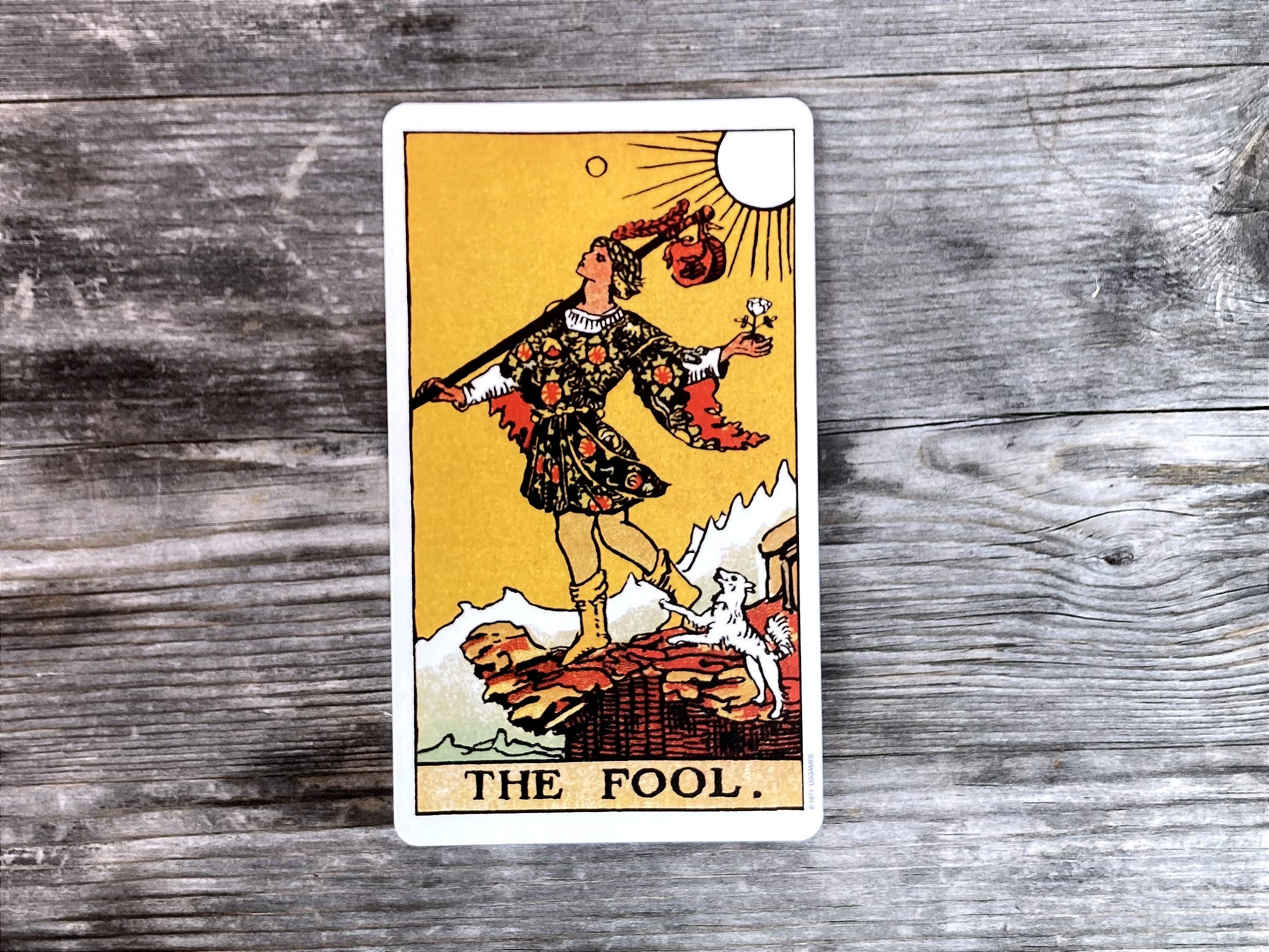
It can be easy to mistake the Fool for someone reckless, stepping blindly off a cliff.
But perhaps the Fool isn’t foolish at all.
Maybe the Fool is simply the only part of us willing to act before confidence arrives.
Rachel Pollack, one of the great writers on the Tarot, puts it beautifully in Seventy-Eight Degrees of Wisdom:
“For those willing to take the chance, the leap can bring joy, adventure, and finally, for those with the courage to keep going when Wonderland becomes more fearsome than joyous, the leap can bring knowledge, peace, and liberation.”
The leap isn’t certainty. If anything, it’s the moment we stop waiting for certainty. It’s the subsequent decision to trust ourselves before reality has given us evidence that things will work out.
The practical action often comes later. The resignation. The difficult conversation. The breakup. The plane ticket. The move.
But something irreversible has already happened:
We’ve stopped arguing with what we already know.
When we packed up our flat in Germany, I expected to feel excitement. After years of preparing, the move back to Canada was finally happening. Instead, I found myself moving through days filled with hesitation, uncertainty, and self-doubt.
More than anything, I was surprised by how quickly my confidence disappeared. I’d spent years imagining this move, yet somewhere between selling our furniture, packing suitcases, and boarding the plane, there was one thought I couldn’t shake.
What if this doesn’t work?
I think every significant transition asks us some version of that question.
One part of me knew there was nothing left for me where I was. Another wondered whether I could really begin again—whether I could build another life from scratch, and whether the vision I had carried for so long would actually become something real.
I don’t think either part was wrong.
Perhaps this is what the Fool has always been pointing towards. Not recklessness. Not impulsivity. But the willingness to begin again after we have already built something worth grieving.
Part III: The Grief of Growing
Why growth often feels like loss.
If there is one lesson life has returned me to again and again, it is this:
Grief is a natural consequence of beginning again.
Every meaningful beginning asks something else to end. Sometimes that grief belongs entirely to the chapter we are leaving. Sometimes it reaches much further back.
One evening, a few weeks after arriving on Vancouver Island, my partner and I drove up to Mount Tolmie, a hill overlooking the city, to watch the sunset. It had been one of the first days since arriving where I’d stopped thinking about paperwork, logistics, and rebuilding a life. Standing there, looking out across the city, I remember thinking,
This feels right.

And then, almost immediately, another memory surfaced.
I was fifteen again, standing at a bus stop after my last day of high school in Toronto, on the other side of the country. I’d only just begun to feel settled. I’d only just found a group of friends who felt like home. Now I was saying goodbye to all of them.
I can still picture that bus stop. I can still remember the feeling of leaving something that had finally begun to feel right.
I hadn’t thought about that afternoon in years. Yet standing on that hill overlooking my new home, the memory surfaced as though it had happened yesterday.
We often assume our emotions belong only to the moment we’re living. But they don’t. Sometimes joy brushes against an old grief. Sometimes relief awakens a loss we thought had long since passed. The present has a way of reaching back into the past, and for a while, both experiences can exist at the same time.
Over the years, I’ve watched that same pattern unfold repeatedly in my psychosomatic practice. People rarely arrive believing they are standing at the threshold of a new season of their lives. They come because life has become heavier. Relationships feel more strained. Their bodies feel exhausted, restless, tense, or strangely disconnected. They assume something inside them has broken.
But as we begin paying closer attention, a different picture often emerges.
What they are experiencing isn’t a breakdown.
It’s movement.
One thing I find interesting is how often the very first signs of healing are mistaken for deterioration.
Someone finally stops abandoning themselves, and suddenly, a relationship becomes more volatile. Someone spends years pushing through exhaustion, only to become ill the moment they finally slow down. A career that once felt meaningful suddenly becomes almost physically unbearable.
From the outside, it can look as though everything is getting worse. More often than not, what we’re witnessing isn’t deterioration at all. It’s what happens when a person finally stops overriding themselves. The body is no longer willing to stay quiet.
And the longer we have ignored it, the louder that conversation often becomes.
Take anger, for example. Clients often arrive frightened by it, assuming it means they are becoming less regulated or that something is going fundamentally wrong. Yet what we’re often witnessing is the emergence of a healthy boundary that has been suppressed for years. The anger isn’t the problem. It’s often the first physical sign that a system which has remained silent is finally beginning to move.
Over the years, I’ve realised that this is what so much of psychosomatic work is really about. Not removing discomfort, but learning to interpret it.
Some discomfort tells us something is unsafe.
Some tells us something has come to an end.
Some belongs to grief.
Some appears because we are growing beyond the life we have known.
Learning to tell the difference is the work.
I’ve started to wonder whether many of the experiences we describe as feeling stuck are, in fact, what it feels like to hold on to something that can no longer carry us forward.
A role.
A relationship.
An identity.
A way of living that has reached its limit.
Maybe this is why grief matters so much.
Grief has movement built into it. Holding on does not.
And the uncomfortable truth is that beginning again is awkward. We leave roles we understood for ones we haven’t yet learned. We exchange competence for uncertainty. We become beginners again, and beginners rarely look like they belong.
We don’t begin because we already belong.
We begin, and belonging catches up. It happens through returning. Through showing up after the first awkward attempt. Then the second. Then the tenth. Until one day you realise you’re no longer the beginner you thought you were.
Part IV: Building the New Life
Nothing compounds yet.
There is a certain relief that comes when we finally stop arguing with reality.
After years of trying to make something work, there is something profoundly freeing about admitting that it no longer does.
The relationship has ended.
The career has ended.
The country has ended.
The version of ourselves that belonged there has ended.
For a while, that honesty feels like taking a full breath after holding it for years.
And then another task quietly begins:
Building.
The chapter may have changed. But the new life isn’t waiting for us fully formed. It has to be built, brick by brick.
One of the greatest mistakes we make during periods of transition is comparing foundations with finished buildings. Someone starts a business and compares their first year to someone else’s tenth. Someone leaves a relationship and compares being alone to a fully developed partnership. Someone moves countries and compares their first few weeks to years of accumulated friendships, routines, and familiarity.
Of course the beginning feels inadequate. We are comparing something that has only just begun with something that had years to take shape.
I’ve been reminded of this repeatedly since moving to Canada. There were unfamiliar systems to learn, a business to rebuild, housing to find, and an entirely new life to assemble piece by piece. What surprised me wasn’t how difficult those tasks were, but how much energy they demanded before anything really began to compound.
At first, your days become full of effort. You spend hours solving practical problems, navigating new routines, and orienting yourself to a different reality, while very little seems to change on the surface.
Yet this is exactly how a life is built—not through dramatic breakthroughs, but through hundreds of ordinary decisions that gradually become familiar.
A few weeks after the move, I joined my first Tai Chi class. I walked into the hall and was definitely the youngest person there, possibly by about twenty years. I spent most of that first class feeling slightly out of place.
I found a spot near the back where I could quietly follow along. About a quarter of the way through the class, the instructor repositioned me in the middle of the group, surrounded by people who knew the movements far better than I did.
It made sense.
From there, I could look around, follow their bodies, and let the group carry me a little. There was something unexpectedly relieving about not having to figure it all out on my own.
At one point, I asked whether my weight should be in my left leg or my right as we shifted between positions.
The instructor looked at me and simply said, “Stop thinking so much. Just watch.”
It wasn’t the answer I wanted.
I wanted to understand before I moved. I wanted to know I was getting it right. Instead, she was asking something very different of me:
To stop leading with my mind and allow my body to learn through experience.
I suppose that’s exactly what beginning again asks of us. We spend so much energy trying to do the new life correctly that we forget to simply participate in it.
I think this is how a new life gradually comes together: through living it.
Part V: Endings Folding Into Beginnings
The cycle continues
I wish I could end this essay by telling you everything worked out.
That I arrived in Canada, settled into a new life, rebuilt my business, found my community, and that everything now feels exactly as I’d hoped it would.
The truth is, I’m still working on it.
Every week, there are new routines to learn, new people to meet, new parts of myself that are still catching up with the decision I made months ago.
Lately I’ve found myself returning to the image of the ouroboros—the ancient symbol of the snake consuming its own tail—it also happens to be my business logo. It’s a reminder that endings and beginnings are never really separate events.
One eventually becomes the other. We often think of shedding a skin as a single event.
It isn’t.
It is a rhythm.
Growth asks it of us again and again. Healing does too.
The older I become, the more the ouroboros feels less like mythology and more like ordinary life. Just when we think we’ve finally arrived, life quietly asks us to begin again.
And maybe that’s the real work.
Not learning how to leave.
Not even learning how to begin again.
But learning to trust the developmental process itself.
To trust that every ending is in some way preparing the conditions for another beginning.
That grief makes movement possible.
That belonging grows through returning.
That a life is built in ordinary days, long before it feels complete.
And perhaps most importantly—
that we do not begin again as the same person who left.
🎧 Listen to the Podcast: When You Outgrow Your Life is also available on Spotify and Apple Podcasts.
Tanya Master is a psychosomatic consultant and developer of the Psychosomatic Restoration Method™. She works with the gap between what we understand about ourselves and the patterns we continue to experience and repeat.
What a joy of an essay, beautifully written. Navigating so manu pf the nuances of starting again. Happy to hear you’re settling in Canada. Fingers crossed!
Wow Tanya that was beautiful! And congratulations on the move! It was incredibly comforting to read that as I've just recently moved to Maine from the Dominican Republic. I wish you all the best on your new endeavors and thank you for putting the experience of starting anew into such an encouraging reminder. It's nice to know we're on the same continent, still far away, haha, but on the same continent!