


Most people don’t recognise they’re grieving until their body breaks down in ways they can no longer manage, medicate, or explain. I see this most often in high-functioning, high-responsibility women whose systems have carried too much for too long. When I talk about grief here, I’m not only referring to bereavement. I mean the quieter, often invisible losses most people never name:
the loss of safety or belonging
losing a life you thought you’d have
the loss of a relationship that never quite worked
the loss that comes with migration, transitions, or starting over
the loss of needs that were never met in the first place
the loss created by years of holding everything together alone
These losses rarely show up as “grief.” They appear as stress, burnout, shutdown, and physical symptoms that don’t respond to the usual solutions. Life keeps moving, and the body becomes the place where unacknowledged loss accumulates.
This article explores how unprocessed grief becomes physical, why it happens, and how psychosomatic work makes space for integration without forcing emotional excavation.
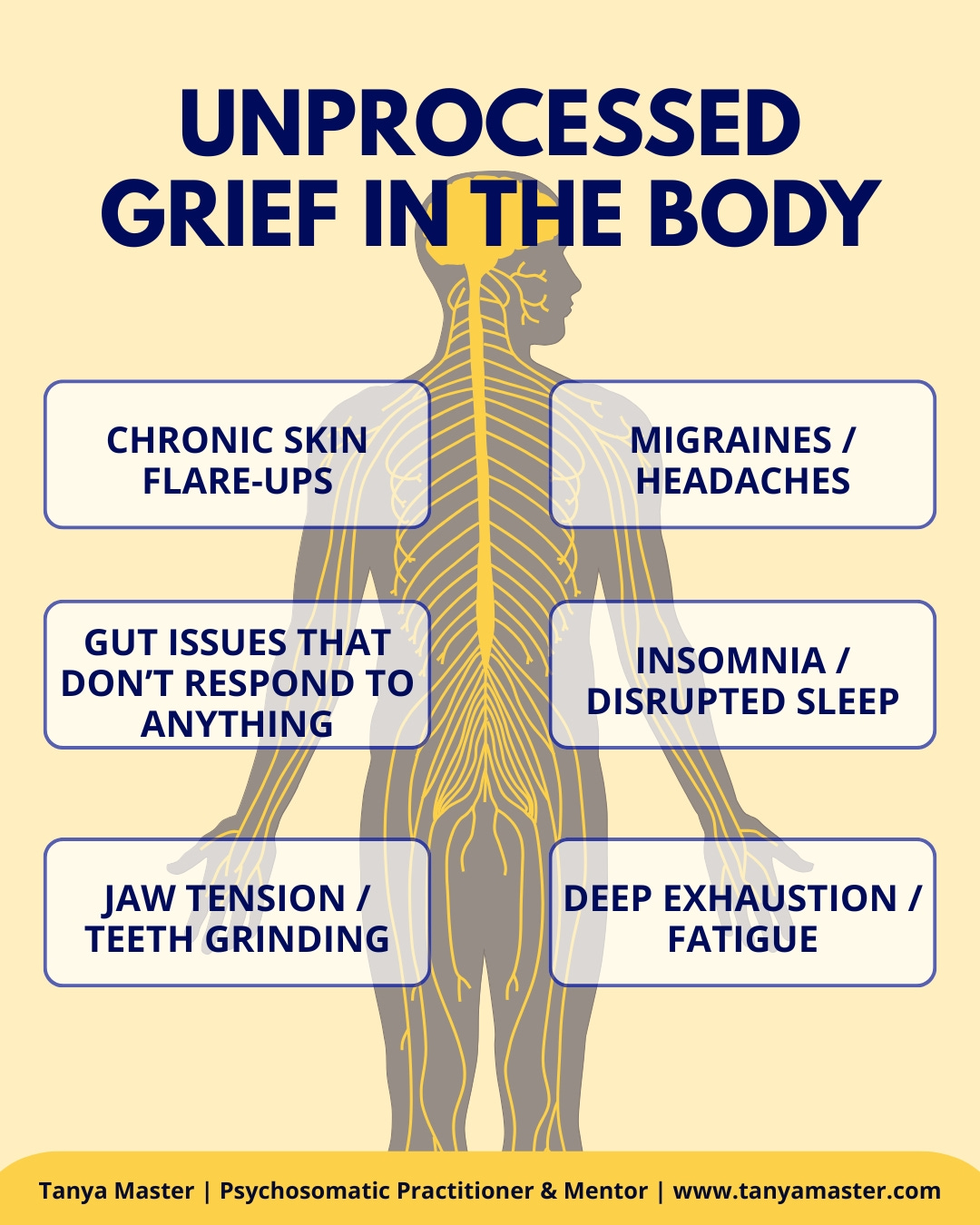
These physical symptoms summarised in the graphic above are some of the most common ways unprocessed grief shows up in the body
If you’re curious about how growth or big life shifts can stir up old emotional material, you may appreciate my earlier piece:

The Hidden Face of Grief: Why the Body Speaks First
For many people, especially those who’ve spent years staying strong and “pushing through,” the body is the first part of the system to communicate that something isn’t okay. When overwhelming feelings are pushed aside so life can keep moving, they don’t vanish. They settle into the nervous system. They appear as tension, fatigue, pain, shutdown, or symptoms that seem to come out of nowhere. Coping in this way is your system’s way of protecting you. In those moments, your body and mind found the wisest way they could to help you survive.
There were seasons in your life when you couldn’t fall apart: children to care for, work to hold together, people depending on you, or families where feeling wasn’t safe or welcome. Not feeling was how you survived. It was how you stayed functional. It worked for a time.
But no survival strategy lasts forever. Eventually something shifts. Either life finally slows down or the body forces it to.
This is why symptoms often intensify during or after:
burnout
illness
a major personal or professional transition
unemployment
kids leaving home
a breakup
moving countries or cities
a period of unexpected stillness
It isn’t that the symptom is “getting worse.” The system finally has enough space for what’s been held underneath. The nervous system reads the pause or the collapse as a small window of safety. In that window, the unfinished emotional material comes to the surface. Not to overwhelm you. But because it’s finally possible. These physical expressions of grief are not random. They are patterned communication from a system that has carried too much, for too long.
Common expressions include:
chronic skin flare-ups
migraines or pressure headaches
persistent gut issues
hormonal changes linked to long-term stress
disrupted sleep
jaw tension or clenching
deep exhaustion
emotional surges that feel “out of nowhere”
These psychosomatic symptoms often intensify when the usual psychological strategies — staying busy, analysing, overriding, numbing — stop working.
The body isn’t breaking down. It’s speaking up.
Why High-Functioning Women Experience This Most
In my psychosomatic practice, I see this pattern most often in women who have spent years carrying more than anyone realises. They hold the emotional load in their families, manage the relationship dynamics, keep their work running smoothly, and absorb tension so others don’t have to.
Many of them grew up learning that staying composed was safer than showing how they felt. They became the reliable one. The calm one. The person who holds everything together. And life continued to reward these traits.
For a long time, this works. It helps you function. It keeps the peace. It allows you to show up in the ways people expect.
Then something begins to shift. Not dramatically at first, but quietly. Symptoms appear and refuse to disappear. A client will tell me she “doesn’t have time to be tired,” even as her body keeps pulling her into migraines. Another will say she is “managing fine,” while her digestion has been shutting down for months.
The truth is simple: Her mind learned to stay functional. But her body never agreed to the contract.
The very qualities that help her succeed in the world make it hard to turn towards what she has pushed away. Reliability becomes over-responsibility. Composure becomes self-silencing. Strength becomes the inability to soften or be supported.
The body steps in where the mind stepped out, not to be difficult, but to finally be heard.
What looks like stress or being overwhelmed is often something deeper: grief with no language, anger that never had a place, boundaries that were never allowed, and emotional compression carried for years.
This is the moment the body begins to grieve what the mind could not.
Grief Doesn’t Begin With Emotion — It Begins With Sensation
In psychosomatic work, grief isn’t something we talk our way into… or out of.
It is approached as a sensation sequence: listening to the body’s cues as its way of signalling that something hasn’t been felt yet. This might show up as pressure, tightness, heat, heaviness, or even numbness long before any emotion becomes clear.
These symptoms do not need to be fixed or forced into release; they need to be approached with curiosity. They are openings.
The point is not to push the body into big emotional expression, but to build enough internal capacity that the system can tolerate what has been held for years.
In my psychosomatic practice, these sensations are often understood as a part of you trying to be heard — a protective part that has been carrying something alone for a long time. We don’t override it or analyse it from a distance. We make gentle room for it, so the body doesn’t have to express everything through pain or shutdown.
How Psychosomatic Work Supports This Process
My work brings together somatic therapy, IFS-informed parts work, and nervous-system mapping to help clients understand and meet what their body is expressing. The aim isn’t a big emotional release. It’s helping your system make sense of itself, so the body, the mind, and the internal parts stop working against each other and start working together.
The process supports clients to:
1. Understand the function behind the symptoms
Why this symptom? Why now? What part is being protected or expressed?
2. Regulate at a nervous-system level
Not “calming down,” but widening capacity so the system can stay present with what arises.
3. Rebuild a relationship with the body
Instead of fearing symptoms, clients learn to read them as intelligent signals rather than threats.
4. Make meaning for the parts that never got to feel what they needed to
Grief is not only sadness — it is unmet need, rupture, anger, longing, boundary, and identity.
Grief has many forms. And it deserves more than one way to heal.
Why This Matters
When grief is not processed consciously, the body holds it. And held long enough, the holding becomes the symptom.
This is why so many chronic conditions do not respond to: medication, lifestyle changes, supplements, cognitive strategies, or mindset techniques.
Because the problem isn’t behavioural… It’s structural. It’s emotional. It’s somatic. And it’s almost always relational. And the nervous system will continue expressing the truth until it is acknowledged.
If this resonates
If something in your body responded as you were reading… a tightening, a heaviness, a pressure, a numbness — that is often where the grief lives.
This work may be supportive if you’re navigating:
chronic symptoms with no clear medical cause
emotional overwhelm that feels disproportionate
a sense of burnout that won’t resolve
long-term boundary collapse
numbness or emotional disconnection
relational exhaustion
repeating patterns even after years of inner work
A gentle somatic cue
Before you close this page, take one slow breath and notice the part of you that softened, or the part that tensed, or the part that went blank. You don’t need to interpret it. Just notice. That is the beginning of grief making itself known.
Related piece for a deeper dive into this theme:
Root Shock: Why Growth Often Brings Grief
·As an integrative psychosomatic therapist, one of the most consistent phenomena I witness is this:
