


This piece is close to my heart and the foundation of why I use the word psychosomatic in my practice. In this article, I unpack what psychosomatic really means and why it matters so much in trauma-informed somatic work.
The method I use, which is a form of psychosomatic coaching grounded in IFS-informed approaches and nervous system attunement, helps clients move beyond symptom management toward deep integration. This is why reclaiming the word psychosomatic isn’t just semantic. It’s structural.
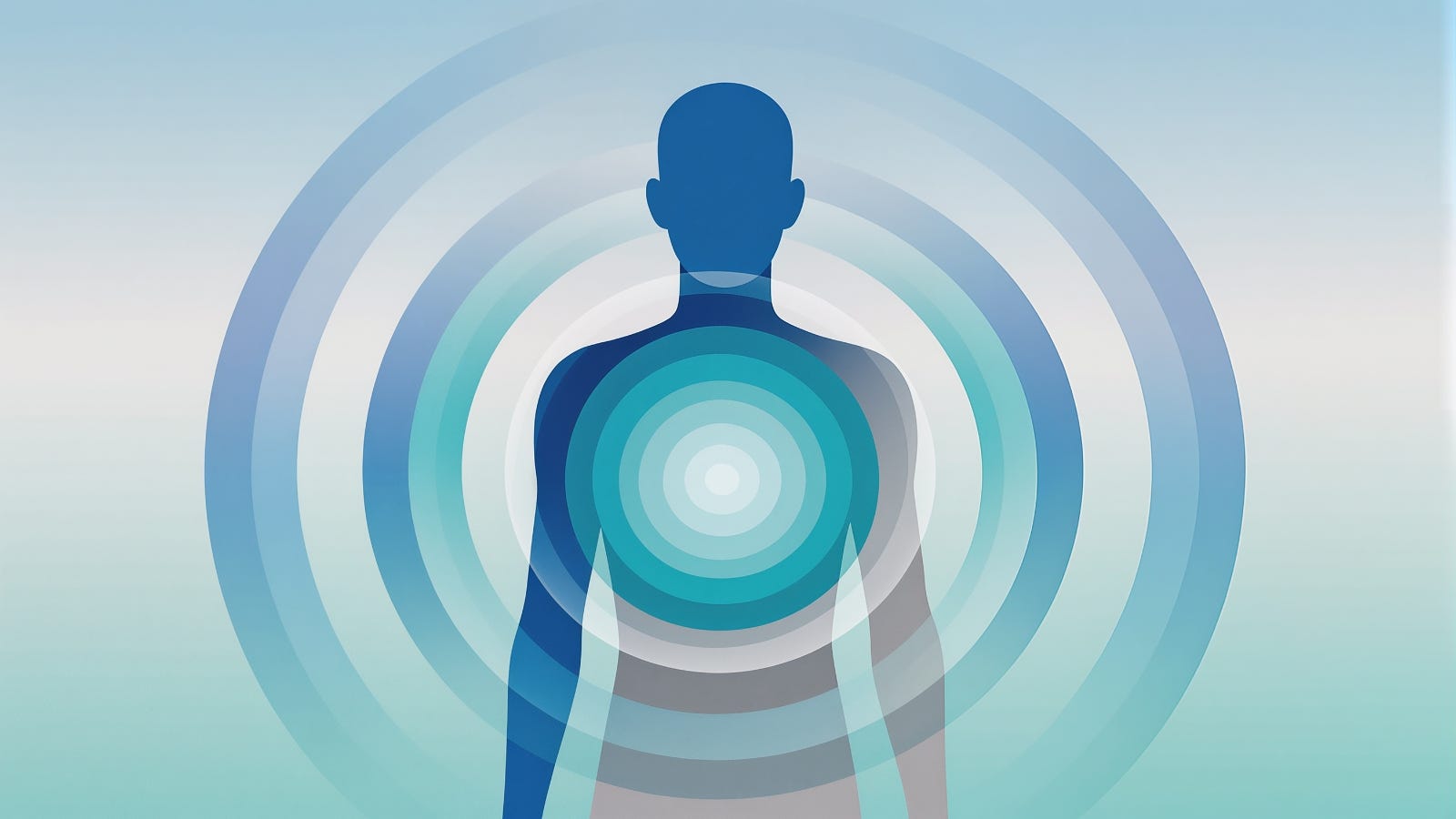
Why the Word ‘Psychosomatic’ Matters
The word psychosomatic is often misunderstood. If you’ve ever been told your physical symptoms are “psychosomatic,” you may have felt dismissed; like the pain wasn’t real, or like you were being blamed for imagining it.
In medical systems, it’s often shorthand for “stress-related,” used when nothing shows up on a scan or blood test. But this can land as: It’s all in your head. Meanwhile, the symptoms remain… lived, painful, and disruptive to daily life.
This misunderstanding creates a false binary: either the issue is physical and “real,” or emotional and “not real.” But that’s not how the body works. And that’s not what psychosomatic really means.
In its original definition, psychosomatic refers to the interconnection between psyche (mind) and soma (body). It reflects a truth that trauma-informed somatic work has long recognised: our histories live in tissue, posture, breath, digestion, and skin. And when emotional material hasn’t been fully processed — especially after overwhelm — the body often takes on the burden of holding it. As Gabor Maté writes:
“Learn to read symptoms not only as problems to be overcome but as messages to be heeded.”
What It Means in the Psychosomatic Restoration Method™
This is why I choose to use the word psychosomatic in my work. It’s not a diagnostic label, but a frame for understanding the intimate relationship between body, mind, and relational history. I’ve spent years working with clients who arrive with persistent symptoms — physical, emotional, and relational — that don’t respond to conventional approaches. What they need isn’t more mindset work or symptom management. What they need is a way of listening to the body as a storyteller.
The Psychosomatic Restoration Method™ — which I’ll refer to it as The PSR Method™ for short throughout this article — grew out of this need: to honour the body’s symptoms as messengers, and to offer a structured, trauma-informed way of responding to them.
The PSR Method is a body-based, trauma-informed approach I’ve developed over years of clinical informed integrative work with clients navigating chronic tension, persistent symptoms, and relational overwhelm. It integrates somatic trauma therapy, parts work, and systemic principles to help people not just understand their symptoms, but actually listen to them.
This method is rooted in a simple but often overlooked premise:
Your symptoms are not random. They are meaningful messages from your body, shaped by your history, your nervous system, and the roles you’ve had to play relationally in order to survive.
Rather than focusing on “fixing” a problem or getting rid of symptoms, we approach the body as a system that is always trying to help… even when its strategies feel uncomfortable or confusing. This method offers a structured, integrative way of engaging with those strategies, and gently exploring the deeper intelligence behind them.
Here’s what defines the PSR Method:
It’s body-based. We begin with sensation. Sessions are grounded in what you feel in your body, not just what you think or say. We follow tension, pain, shutdown, or emotional overwhelm as invitations to explore what your body is holding, and why.
It’s trauma-informed. We don’t push for catharsis or re-traumatise by digging too quickly. Instead, we honour your system’s pace, attune to nervous system states, and work collaboratively with the protective parts that arise.
It’s symbolic and systemic. Symptoms often carry metaphor. For instance, insomnia may hold unspoken fear or confusion. Skin flare-ups may reflect unprocessed anger. We explore these patterns gently, without pathologising. We also look at the relational and systemic dynamics that shaped your roles; in family, culture, or identity.
It’s nervous-system oriented. Fight, flight, freeze, and fawn aren’t just psychological buzz terms — they are lived states. They become default postures that unconsciously shape how we show up in the world. In this method, we work to gently shift those postures by building capacity for regulation — not through performance, willpower, or effort, but through slow, attuned awareness. Using pacing and titration, we help the nervous system register new possibilities for safety, connection, and rest.
It’s parts-based. Many symptoms emerge from parts of you that carry specific burdens — like fear, shame, grief, or responsibility. Using IFS-informed approaches, we explore how symptoms may reflect exiled parts or overfunctioning protectors that have not been met with curiosity before.
It’s clinically rigorous and deeply integrative. This method weaves together training in somatic trauma therapy, systemic constellation work, psychosomatic coaching, and reflective supervision — all within a trauma-informed framework. It is especially suited to high-functioning, highly sensitive, gifted, or neurodivergent individuals who often carry histories of subtle chronic stress, relational misattunement, or emotional complexity that may not have been fully recognised in prior support.
What makes this method unique is that it doesn’t treat the body as separate from the psyche or the social world. It sees your symptom as a relational signals: something shaped by internal dynamics, external systems, and a history of having to adapt in ways that made sense at the time.
This work is all about slowing down, listening in, and rebuilding the trust between your body, your story, and your sense of self.
Who It’s For (and What It Helps With)
Psychosomatic work is often sought out by individuals who are highly functional on the surface, but internally feel stuck, disconnected, or in a chronic loop. They may have tried various forms of talk therapy, mindset coaching, or even somatic approaches — but something still doesn’t shift. Symptoms keep returning. The same relational patterns resurface. The body continues to signal distress, even when life looks “fine” from the outside.
This method is especially suited for people who:
Feel emotionally intelligent but repeatedly overwhelmed by the same triggers
Have done years of insight-based work, yet still feel fragmented, numb, or collapsed
Carry persistent physical symptoms that medical testing doesn’t explain
Struggle with complex relational patterns (especially in love, family, or leadership)
Live in states of fawn, freeze, or self-doubt and can’t seem to “break through”
Are ready to stop managing their symptoms and start listening to them
These are often individuals who have had to override their bodies for years — whether through caregiving, masking, people-pleasing, overachieving, or surviving systems that didn’t feel safe. The nervous system adapted by turning down certain signals and turning up others. Over time, this often results in the body speaking up… not always in words, but through discomfort, depletion, or dysfunction.
This work helps with:
Chronic stress and anxiety
Relational burnout or trauma patterns
Digestive issues, fatigue, hormonal imbalances
Unexplained physical symptoms (including pain, skin issues, bladder or gut dysfunction)
Difficulty sleeping or resting
Cycles of collapse and shutdown after periods of high productivity
Shame around being “too much” or “not enough”
Importantly: the goal is not to diagnose or fix. It’s to understand. To approach symptoms as messengers of strategies that are no longer working, have become outdated, or are causing harm. And to honour the deep intelligence of the body’s way of adapting.
What Happens When You Reconnect Somatically
Often, people come to this work after trying many approaches. They’ve done the mindset work, the talk therapy, the medical testing and treatment. And yet, something still doesn’t shift.
That’s often because the nervous system hasn’t caught up with the insight they’ve gained. Cognitive clarity doesn’t always bring physical relief. The body may still be operating from a familiar survival pattern. One that once protected, but now limits.
When you begin to reconnect somatically — to track sensation, name internal parts, and notice what your system is doing in real time — something shifts. And it’s not always dramatic (though sometimes it can be). Often, the shift is subtle:
You pause instead of pushing.
You sleep through the night.
You say no.
You feel hunger.
You stop overriding discomfort just to keep the peace.
These small shifts matter. They signal that the body no longer needs to speak through symptoms to get your attention.
Over time, psychosomatic reconnection helps clients:
Reclaim a sense of internal coherence — where thoughts, feelings, and actions are aligned, not in conflict
Build nervous system capacity — to move through life without chronic tension, shutdown, or overwhelm
Clarify boundaries and needs — not as concepts, but as embodied signals that feel safe to express
Move from identifying with symptoms to listening to them — recognising them as messengers, not enemies
Re-pattern relational dynamics — especially for those who’ve spent a lifetime people-pleasing, performing, or collapsing
In trauma-informed psychosomatic work, the goal isn’t to get rid of symptoms at all costs. It’s to understand what the symptom is trying to say and to build the internal safety and structure to respond differently.
A Final Word
When you begin to listen to the body with care rather than override it with tools, mindset, or medication alone; you open the door to integration. And when integration happens, healing becomes sustainable.
This work isn’t about forcing change. Rather, it’s about creating the conditions in which change becomes possible. Often, the clues for how to do that are already present in the body.
Symptoms aren’t random. A subtle discomfort, a chronic flare-up, or a sense of heaviness may all carry embedded messages. Often pointing to something in your environment — relational, emotional, or physical — that needs more care, protection, boundaries or change.
When you begin to relate to symptoms this way, you create room for change. You move from identifying with them to responding to the need beneath them.
Sometimes, that might mean saying “no” when you’re used to saying yes. Or choosing rest instead of performance. When subconscious needs become conscious ones, the body no longer has to carry them alone.
Integration Prompt
If you’re currently navigating a persistent or confusing symptom try approaching it as a messenger.
You might begin with this journaling prompt:
“What are you trying to protect me from by being here?”
Once you have a sense of the answer, ask:
“What is one way I could help take the pressure off this symptom, by taking that need seriously this week?”
This is not about finding a quick fix. It’s about starting a different kind of relationship with the parts of you that speak through discomfort. One grounded in respect, curiosity, and care.
If this resonates, I’d love to hear from you in the comments, or to know what your symptom is beginning to say.
Ready to explore this work?
If you’re navigating persistent symptoms, chronic stress, or relational patterns that feel stuck — I offer introductory sessions and structured 1:1 support rooted in the Psychosomatic Restoration Method™.
If you’re a practitioner, coach, or therapist looking to deepen your own trauma-informed or psychosomatic lens, I also offer consultation and mentorship.