


Many high-achieving or high-functioning individuals arrive in coaching describing themselves as stuck. Trapped in cycles of procrastination, avoidance, or resistance. These patterns are often seen as barriers to push through.
In my psychosomatic coaching practice, I see this regularly, particularly among leaders, entrepreneurs, gifted individuals, and those with a history of pushing beyond their limits. Beneath the surface of this common challenge is usually an internal polarisation: competing impulses pulling the system in opposite directions.
One part drives forward with ambition or pressure to perform. Another part holds back, expressing a boundary the mind has learned to override.
This inner stalemate is well illustrated by the Two of Swords from the Tarot.
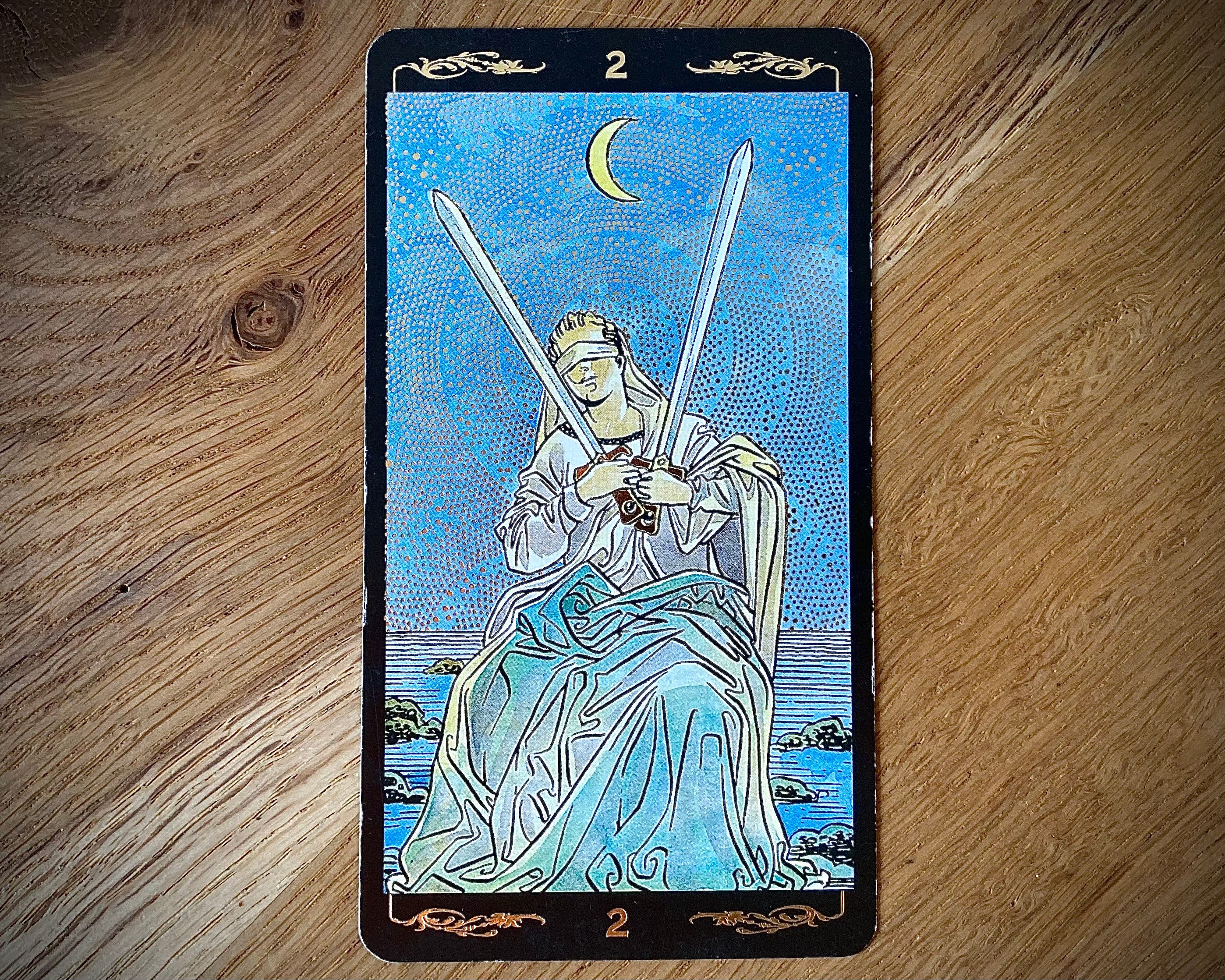
In the Golden Dawn deck, a blindfolded figure sits with arms crossed, holding two heavy swords in opposition. Behind her, still waters dotted with rocks signal potential danger beneath the surface. Her posture reflects a system frozen in tension, locked between action and withdrawal.
The swords symbolise the internal polarity: protective strategies pulling in opposite directions. Self-protection versus exposure. Withdrawal versus engagement.
This image of the Two of Swords perfectly mirrors the body’s contradictory responses under stress. The figure is immobilised, yet holds weapons ready for defence. The blindfold adds another important layer, reflecting disconnection from deeper emotional truth. The waters of unprocessed experience behind her. Notice her open mouth, showcasing the distress, like the body gasping for air under strain.
From a psychosomatic perspective, this tension shows how the body expresses unresolved conflict. Competing survival strategies tighten the chest, constrict breath, and replace clarity with fogginess or indecision.
If you find yourself here, know that this isn’t a dysfunction. It is the body’s best attempt to manage overwhelm, a pattern I frequently witness in high-functioning individuals navigating burnout, disconnection, or a loss of direction.
Often, these dynamics trace back to early relational experiences. Many clients learned from a young age to override their body’s boundaries—whether through family systems that rewarded achievement, environments where emotions felt unsafe, or caretaking roles adopted too early. Over time, the system adapts by splitting: one part drives forward to cope or succeed, while another part withdraws to protect.
The body holds this pattern too. It often shows up physically as tension, pain, or dysregulation; commonly in the head, neck and shoulders, lower back, or gut. What begins as an internal conflict between opposing parts eventually manifests somatically, reinforcing cycles of stress, fatigue, or shutdown.
This strategy may have been necessary once, but left unexamined, it becomes the source of stuckness, burnout, and internal conflict later in life.
The Wisdom of Stuckness
In performance-driven environments, stuckness is frequently misread as weakness. Clients often arrive seeking tools to override resistance or reignite motivation. It sounds like: “I know I’ll feel better if I push through the discomfort” or “I think I’m just not trying hard enough.”
But in somatic parts work, procrastination, avoidance, or shutdown are reframed as protective signals. When a client says, “I don’t know why I’m not doing the thing I say I want to do,” we don’t force behaviour change. We slow down and listen.
Nearly always, there’s a valid reason beneath the resistance.
Often, the system is protecting boundaries, dignity, or psychological safety. That protection may show up as tiredness, fogginess, or withdrawal. When taken seriously, a deeper truth emerges—the same one the figure in the Two of Swords avoids facing.
Listening to the Body’s Boundaries
A client recently described her experience at a group embodiment retreat designed to promote connection and presence through massage and conscious touch. Her intention was to feel more embodied, explore intimacy, and connect with others on a deeper level. But once there, strong internal resistance surfaced: discomfort with touch, withdrawal from social contact, and general unease throughout the retreat. She judged this response as a relational block. A behaviour she thought she needed to overcome.
Instead of overriding her resistance, we explored it non-judgementally in session, asking the part that was holding back how it might be protecting her.
Its answer was crystal clear: “I don’t feel safe being touched by strangers.”
In that moment, it was obvious to me as a practitioner that her body was drawing a clear boundary. But I could also see that she hadn’t quite heard it—because another part of her, shaped by social conditioning, was already judging the boundary.
I paused and reflected it back to her. “Did you hear what that part of you just said? Your body’s withdrawing because it doesn’t feel safe being touched by strangers. That actually sounds pretty valid.”
Being met with that reflection; the validity of her body’s response; shifted something. The self-judgement began to soften. The part that had been so quick to criticise quietened, and her deeper, observing self—the true witness—began to hear what was really happening.
What she had framed as resistance was, in fact, a boundary her system was trying to express.
When Resistance Is Misread as Avoidance
What appears as hesitation, withdrawal, or discomfort is often the body saying: Not yet. Not like this.
Even in spaces claiming to be safe, inclusive, or expansive.
Safety cannot be declared through words. The body reads environment, energy, tone, and relational cues. If the body senses misalignment, no well-meaning language will override that.
This is why one-to-one work matters, especially for those unlearning people-pleasing, performance patterns, or perfectionism. Without group pacing or social expectation, the body’s signals become clearer. We create space to listen, rather than override ourselves for the sake of belonging.
When Motivation Disappears
In another case, a client who had long relied on physical movement; gym sessions, yoga, weight training, constant physical activity; found herself unable to maintain her usual momentum. She labelled herself lazy, frustrated by her lack of drive.
Through coaching, what we uncovered was that physical activity had become a coping strategy layered over complex trauma. But the strategy was reaching its limit. Her system was exhausted from so much physical output. One part of her; the driven, high-functioning protector; used activity to stay regulated. But another part, long ignored and now arising loudly in her system, was asking for rest, softness, and space to process grief.
To bring back the Two of Swords, the water in the background often speaks to exactly this: unprocessed emotions, like grief, from the past.
Her high-output protective strategy, once helpful, was now contributing to burnout.
This dynamic is common in high performers. A system wired for output eventually meets its threshold. One part demands constant striving. Another part resists, expressing exhaustion or grief the system hasn’t yet made space for.
The work isn’t to override those signals, but to build capacity to hear both parts—the one that pushes, and the one that resists—and to support integration at a pace the system can hold.
What Happens When We Listen
In somatic coaching, stuckness is a transformational entry point. Our triggers truly are a gateway. Resistance, avoidance, or shutdown often signal that parts of the system are locked in an old pattern: one side pushes forward, the other pulls back. The result is internal standstill.
The Two of Swords reflects this perfectly. The figure holds opposing (outdated) strategies, yet with no clear path forward. She’s blindfolded and disconnected from the body’s deeper wisdom. But again, this stagnancy isn’t failure—it’s protection, shaped by past experience, survival patterns, and limited options.
The aim of integrative, trauma-informed psychosomatic work, which unites mind and body, is to widen those options. To create capacity where it currently doesn’t exist.
Through somatic and parts-based dialogue, we create room in the nervous system to explore new approaches, in a safe and contained way. Most importantly, this happens and is facilitated through the practitioner–client relationship. Here lies a new attachment model for safety. That is why this work cannot truly be done alone. We heal in relationship.
Here, the rigid ‘push forward or shut down’ binary begins to soften. Instead of override, the system learns to collaborate. Boundaries are respected. Needs are honoured. Momentum returns. Not through force, but through integration.
Often, this process means gently removing the blindfold. Meeting the emotional undercurrent, the stored stories, the unfinished responses from the past, hidden beneath seemingly still waters. As the system learns that the present moment is different from the past trauma, new possibilities emerge. Possibilities rooted in self-trust, discernment, and authentic movement forward.
I’m Tanya, an integrative psychosomatic practitioner and clinical coach. I work with individuals navigating the tension between boundaries, resistance, and authentic growth. If this resonates and you’re ready to explore this work, you can learn more or book an introductory session here.