


In 2025, “trauma-informed” has become a brand asset. It shows up in job ads, company values, and content strategies. It’s the new shorthand for care, ethics, and emotional integrity.

But what happens when that language is used to signal safety, without actually building it?
What happens when organisations don the language of inclusion, but weaponise it as PR?
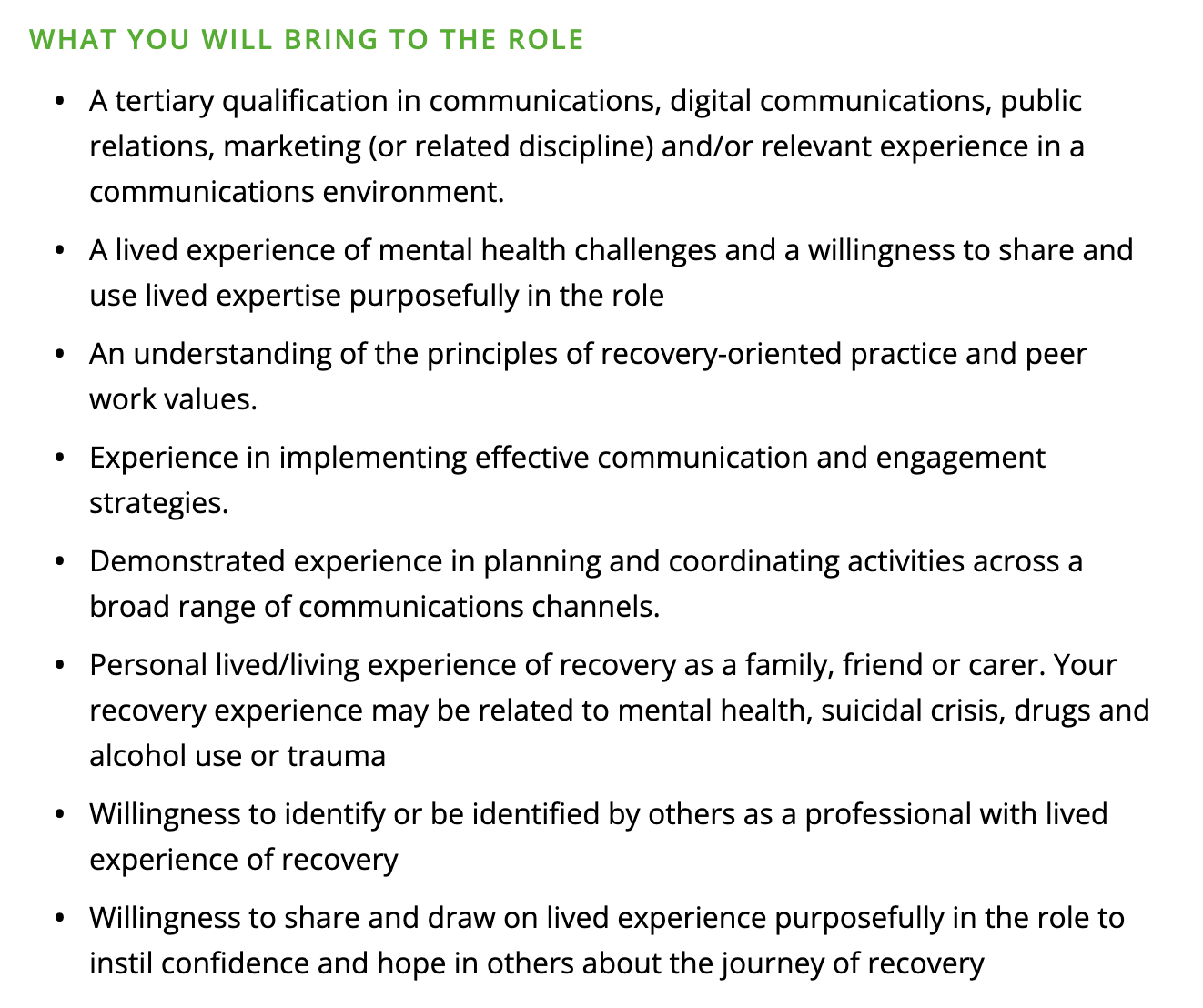
I recently came across a job ad titled “Lived Experience Communications Officer”, posted by a mental health organisation.
The role?
To integrate stories of distress, recovery, and survival into the company’s public messaging.
Just let that land.
A wellbeing organisation asking someone with a history of trauma to package their pain into brand-aligned content.
Why This Can Feel Empowering — At First
At first glance, a role like this can feel validating. Especially for survivors.
One might think:
Finally, my story matters.
Finally, my pain has value.
Finally, I can use what I’ve been through to help others.
But this is what makes trauma marketing so dangerous.
It capitalises on a core wound: the belief that your value lies in your trauma (in how you were harmed or marginalised) not in your skills, capacity, or leadership.
When your trauma story becomes the reason you’re chosen, it reinforces a dangerous dynamic: that your worth is conditional on staying identified with your pain. Over time, this keeps survivors tethered to their victimhood. Not as a site of healing, but as a commodity. And it invites performance, not empowerment.
For many, this mirrors early relational dynamics where care was conditional: offered only when pain was visible, or when the survivor’s image, strengths, or story could be used to serve someone else’s needs.
It’s not just emotional extraction disguised as empowerment, it’s a subtle form of coercive control. One that rewards performance over authenticity, and keeps the individual fused to a victim identity.
It also obstructs differentiation. It limits the person’s ability to evolve beyond their trauma, to inhabit their full personality, or to be recognised as a whole and complex human being.
This dynamic can be incredibly hard to spot. Especially if you’ve spent years trying to make your trauma mean something; and are used to confusing reenactment with recognition.
This job ad isn’t an isolated case.
It just makes a broader pattern unusually visible.
I’m not sharing it to target or criticise this specific organisation. I’m sharing it because it reveals something that often goes unnoticed.
Usually, dynamics like this are hidden. They’re woven into job descriptions, team cultures, or internal expectations. They’re subtle, implied, or disguised in corporate speak.
But here in 2025, something is shifting.
We’re seeing organisations name these dynamics explicitly. Not just in descriptions, but in job titles. The emotional labour of survivors is no longer just quietly expected. It’s being openly solicited, under the banner of ethics, care, and inclusion.
This is how systemic exploitation shows up in 2025:
Wrapped in therapeutic language
Positioned as advocacy
Posted under an "ethical" banner
Emerging from the very spaces meant to offer support and safety
Where Trauma Marketing Thrives
Trauma marketing doesn’t advertise itself as manipulative. In fact, it often hides inside the very systems that claim to offer safety, support, and healing.
These are mission-led spaces. They speak the language of values, recovery, and inclusion; and they attract people who carry lived experience, often hoping to contribute to meaningful change.
But when this language is used as branding rather than structure, it becomes disorienting, and deeply harmful.
And it’s not limited to mental health and wellbeing.
Trauma marketing increasingly shows up across a wide range of values-driven and “progressive” sectors:
NGOs and nonprofit spaces
Mission-led and values-driven organisations
Progressive political and social movements
Community-based organisations claiming inclusivity or social justice
DEI initiatives in large institutions
Advocacy or outreach roles framed around “representation” or “lived experience”
Spiritual or coaching collectives that brand themselves as trauma-informed
These aren’t traditional corporate actors simply co-opting language for optics. They’re organisations where care is part of the brand identity — which makes the harm harder to see, and harder to name.
This is what makes trauma marketing so insidious: it hides in plain sight, within the very environments survivors are taught to trust.
The Rise of Identity-Targeted Comms Roles
In 2025, many organisations use the language of trauma-informed care; but without the training, structure, or leadership accountability to back it up. The result? Roles that look progressive on paper, but operate like emotional PR.
These positions often appear under familiar job titles:
Communications Specialist, Engagement Officer, Content Strategist, Education Coordinator.
But they’re wrapped in inclusion-forward messaging designed to attract applicants from marginalised communities.
Language like:
“We strongly encourage candidates with lived experience of…”
“Applicants from LGBTQIA+, BIPOC, or neurodivergent communities especially welcome.”
But here’s what’s often left unsaid:
Once hired, the unspoken expectation is to:
Translate personal pain into brand-aligned stories
Be emotionally available for public representation
Speak the language of resilience and inclusion, but avoid systemic critique
These roles are rarely positioned for influence. Nestled inside marketing or comms teams, they often lack the authority, structural backing, or mentorship needed to effect real change. They don’t shift how power is distributed or how decisions are made. Instead, they give the appearance of inclusion while keeping marginalised voices at a safe distance from influence. The person’s identity is leveraged to signal safety and ethics, not to centre their leadership, insight, or structural impact.
Meanwhile, companies can claim credibility and relatability, without shifting anything fundamental about their policies, leadership, or internal culture.
This isn’t trauma-informed practice.
This is emotional extraction disguised as opportunity. And behind every role like this, there’s a real person.
What This Actually Does to People
When these dynamics play out, the person with lived experience often ends up:
Tokenised, isolated, and emotionally burdened
Used to "humanise" the brand without any real influence
Seen as a liability the moment they speak up, set a boundary, or question the narrative
Supporting optics that benefit the institution more than their wellbeing
And because many of these individuals are survivors of coercion or relational abuse, they often can’t discern when harm is being reenacted.
This is the tragedy of trauma reenactment:
The nervous system normalises abuse when it’s masked as care. Many are drawn to these roles because they feel familiar — echoing early templates of attachment, where value was conditional and boundaries were blurred.
So the dynamic continues:
People take these jobs hoping to feel empowered. Instead, they are re-traumatised.
Their distress is unseen, their loyalty is exploited, and their silence is misread as consent.
This is the cost of trauma marketing. Not trauma-informed practice.
And it’s deeply destabilising, especially for survivors who think they’ve finally found a place of belonging.
What Real Integration Looks Like
If organisations genuinely value lived experience, that value must be structural, not symbolic. This doesn’t mean hiring people into positions of influence just because of their identity.
It means:
Stop treating identity as qualification
Start prioritising training, skill, and integrity
Recognise lived experience and formal expertise as dual assets
Lived experience professionals must be:
Included in shaping policy, not just messaging (if they have the training and capacity to do so)
Hired into roles with real influence, not just visibility; with safeguards, mentorship, and trauma awareness
Supported to grow ethically and structurally. Not emotionally exploited for brand optics under the guise of progress
Trauma-responsive leadership isn’t a branding exercise. It lives in the day-to-day structure of how decisions are made, who holds power, and how relationally safety is maintained in real time. And that means building cultures where feedback, dissent, and repair are possible. Without cost to the individual.
Because too often, the people brought in to “diversify” a space are the first to be scapegoated when they challenge the system.
Here’s how that can look:
When marginalised team members raise concerns or speak hard truths, they may be met with deflection, avoidance, or subtle punishment.
Their tone is pathologised. Their boundaries are framed as “difficult.” Their professionalism is questioned.
Over time, they are isolated — perceived as disruptive or “too much” — even when they’re naming real gaps in equity or integrity.
This is what institutional scapegoating can look like: when a system protects its self-image by positioning the truth-teller as the problem.
So the question isn’t just: Who’s being hired?
It’s also: What happens inside the system when they speak up?
The solution isn’t performative DEI hires or symbolic inclusion. It’s hiring qualified people — including survivors — who bring real skill, capacity, and clarity. And then giving them the protection, scope, and structural power to actually lead.
The Bottom Line
Truly trauma-informed organisations don’t have to signal safety. They cultivate it.
It’s not in the comms or marketing. It’s in the culture.
If your messaging speaks safety louder than your systems … something’s off. And people feel it in their bodies. They burn out. Check out. Or quietly leave.
❌ Trauma marketing uses the language of healing to gain trust.
✅ Trauma-informed practice builds the conditions of safety to deserve trust.
Safety isn’t something you perform. It’s something you build.
And it’s baked into policy, structure, and decision-making.
About the Author
I’m a psychosomatic practitioner and trauma-informed coach. I support high-functioning survivors, leaders, and change-makers to rebuild nervous system safety, relational trust, and leadership clarity — especially after years of insight or therapy that didn’t lead to real change.
I also work directly with founders and organisational leaders in high-impact roles, offering trauma-responsive leadership development grounded in psychosomatic principles. My work supports structural repair at the level of power, values, and nervous system integrity — not through broad organisational initiatives, but through deep individual recalibration.
If you’re navigating the effects of extractive systems — or leading others through complexity — I offer both 1:1 client work and practitioner mentorship.