I originally wrote this article in response to a widely shared Substack post from a parent navigating estrangement. The original post has since been edited, and some of the language I originally responded to is no longer as prominent, although I think the underlying pattern is still visible. What follows is my own trauma-informed, parts-based, and systemic perspective on why boundaries can become experienced as betrayal in enmeshed families, and what this has to do with the much bigger question of individuation.
I recently came across an article on Substack written by a mother describing her experience of being cut off by her adult children. The piece was emotionally raw and clearly struck a nerve with readers. It wasn’t just rooted in grief, but in a strong sense of abandonment, personal erasure, and helplessness.
What stood out most was how deeply the Victim role was playing out. It felt like the writing came from a part of the system that had fused with helplessness and moral certainty, with little room for self-reflection or relational nuance. It reminded me of a protective pattern I often see in my work as a psychosomatic consultant: a part that’s trying to make sense of pain, but ends up reinforcing stuckness.
From a psychosomatic and relational lens, what I saw wasn’t just grief; it was a kind of freeze—a relational pattern that externalises blame, flattens mutuality, and makes repair feel impossible.
That’s not to say there wasn’t real pain or harm. Estrangement often involves deep loss, rejection, and injustice, and those experiences matter. But when pain fuses with a fixed identity—one rooted in helplessness and certainty about who’s right and wrong—it can block nuance and make genuine connection harder to find.
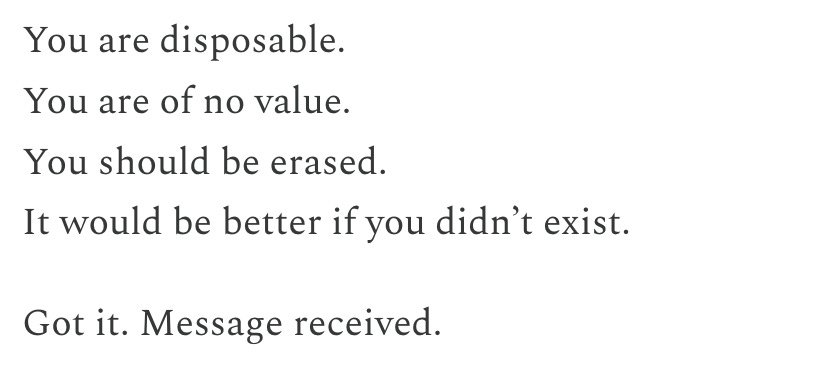
The final lines of the article revealed what the author had come to believe her child’s estrangement meant about her. In effect, she had constructed a narrative of what her child must think of her, without actually knowing whether any of it was true:
Screenshot from the original Substack article.
Look closely at that last line: “Got it. Message received.”
Except no such message was sent—at least, none that we, as readers, are ever privy to.
Throughout the entire article, we never hear from the adult child. We aren’t told what they actually said, thought, or felt. We don’t know the words used or the conditions under which the boundary was set—only that a boundary was set and contact ended.
Yet without hearing a single word from the adult child, the parent’s system translated that boundary into an act of personal annihilation, constructing a narrative about what her adult child allegedly believes: You want me erased.
This is how the Victim stance protects itself.
By projecting the worst possible intent onto the adult child, the parent gets off the hook. She doesn't have to look at the actual history, the boundary itself, or her own role in the fallout. The child’s attempt to choose for themselves gets painted as pure malice, allowing the parent to stay safely locked in the victim role—wronged, helpless, and morally innocent.
The “message received” wasn’t delivered by the adult child at all. It was created inside the parent’s own defended system to justify the role she was already playing.
In high-conflict or enmeshed family systems, this reaction is intimately familiar. Separation doesn’t register as space; it registers as betrayal, abandonment, or even destruction.
Underneath this collapse is a core feature of enmeshment: the parent’s internal map of the adult child has never actually been updated. Instead of recognising the adult in front of them—a separate human being with their own boundaries, needs, and independent centre of gravity—they are still relating to a child. In their inner world, the adult child remains a dependent extension whose choices, feelings, and identity belong entirely to the parent. So when that adult child attempts to individuate—to become their own person—the separation threatens the parent’s very sense of self, turning a necessary boundary into what feels like catastrophic abandonment.
And when the parent can’t face that pain, a rigid, familiar cycle takes over:
The parent locks into the Victim role (“I am helpless, blameless, and entirely blindsided”).
The adult child is cast as the Persecutor (“You are cruel and trying to erase me”).
A third party—whether a relative or, in this case, an online audience—is enlisted as the Rescuer (to validate the parent’s innocence and condemn the boundary).
It’s a pattern I see repeatedly in estrangement stories and a familiar script of the Drama Triangle—a relational blueprint people can unconsciously fall into when a family system lacks the capacity for genuine relational presence.
What Is The Drama Triangle?
When it comes to estranged or high-conflict families, it’s often not just about what happened, but about the relational dynamics that keep repeating.
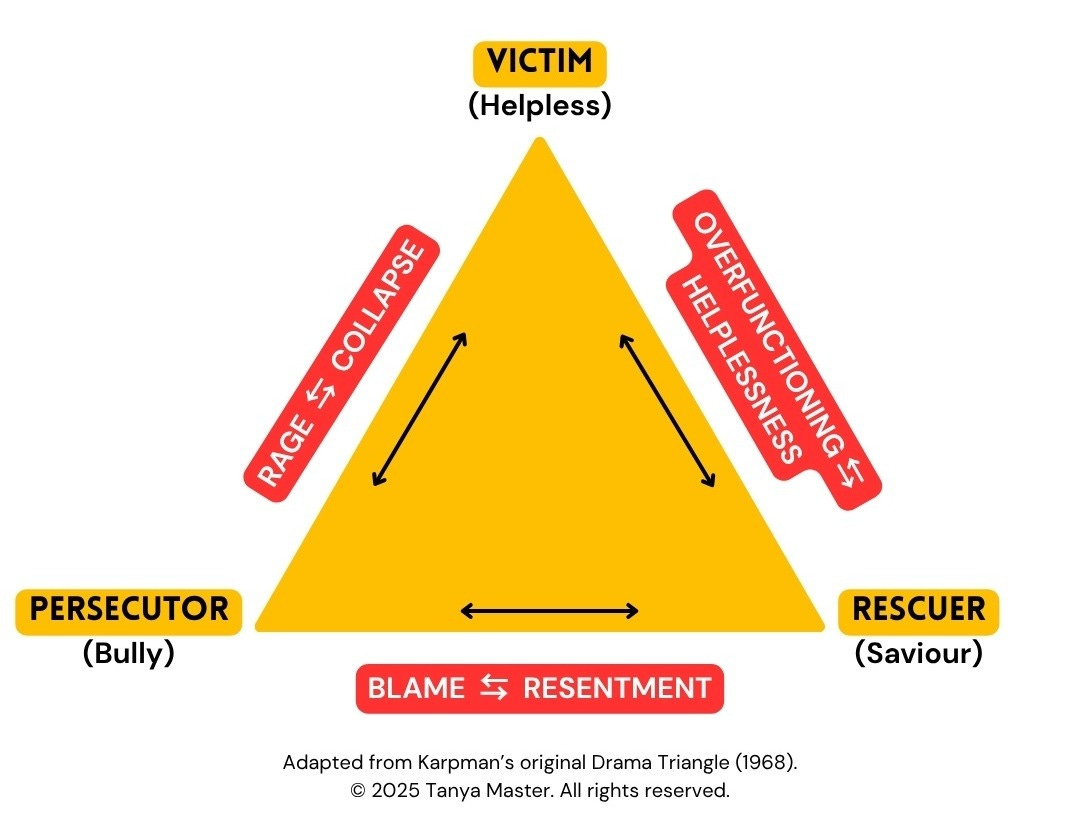
One useful framework for understanding those dynamics is the Drama Triangle, developed by psychiatrist Stephen Karpman in 1968. It maps three reactive positions people can fall into during emotionally charged relationships:
Victim (The Helpless One): Feels powerless or mistreated. May collapse, defer responsibility, or signal helplessness as a way of coping.
Persecutor (The Bully): Criticises, controls, or dominates. Feels justified in anger or blame.
Rescuer (The Saviour/Martyr): Over-helps or over-functions. Gains identity through being needed or fixing others.
These aren’t static identities or personality types. They’re reactive stances shaped by unmet needs, survival strategies, and relational history. Each can also have a corresponding somatic stance: shifts in posture, voice, breathing, tension, and how we position ourselves in relation to another person.
Visualising the Pattern
The diagram above illustrates how each position pulls in the other two relational roles. These aren’t simply three kinds of people. They are three ways of relating, each of which creates a role for the people around us.
The Victim
From the Victim position, other people can become experienced in one of two ways: as someone who will rescue, or someone who will hurt.
The Victim draws in the Rescuer through helplessness:
“Help me. Fix this. Tell me what to do. Take responsibility for what I can’t.”
And draws in the Persecutor through blame:
“You did this to me. You’re the reason I’m suffering. You’re the bad one here.”
If someone refuses to occupy either position—if they refuse to rescue, yet also refuse to step into the role of the villain—the person in the Victim stance genuinely struggles to know how to relate to them. The interaction stalls because they are no longer playing one of the familiar parts.
The Rescuer
The Rescuer requires somebody to rescue, which means they are magnetically drawn toward helplessness. They step in, advise, manage, and over-function—habitually taking responsibility for emotions, tasks, and boundaries that another person needs to carry for themselves.
Over time, over-functioning can sour into resentment:
“After everything I’ve done for you, this is how you treat me?”
In a single shift, the Rescuer flips into the Persecutor position.
The Persecutor
The Persecutor also requires someone on the receiving end of the dynamic: someone to blame, criticise, control, or hold responsible for their discomfort. This can push the other person toward the Victim position—which, in turn, may recruit an outside party to step in and rescue them.
The Currency Around the Edges
Along the sides of the triangle, you can see these exact emotional exchanges playing out in real time:
Helplessness ⇆ Over-functioning between the Victim and Rescuer.
Blame ⇆ Resentment between the Rescuer and Persecutor.
Rage ⇆ Collapse between the Persecutor and Victim.
This is what makes it a closed system. Each position doesn’t just give you a role—it pulls for particular roles from the people around you. And because people rapidly cycle through all three corners, the pattern becomes almost impossible to recognise from inside it, right up until you learn to notice the pull.
From Rescuer to Villain: The Drama Triangle in Estrangement
This is where the Drama Triangle stops being an abstract diagram and becomes something people actually live.
In estranged families, the triangle doesn’t necessarily play out as an overt, conscious war. It plays out in the narrative—the stories people tell about what happened, who is to blame, and what a boundary actually means.
Many adult children who eventually go No Contact didn’t start out as the Persecutor in the family story. They spent years, sometimes decades, in the Rescuer position.
They were the parentified children. From a young age, they felt responsible for meeting the emotional—and sometimes physical—needs of a parent. They were the caregivers, the emotional anchors, the peacemakers, and the problem-solvers—the “good girl”, the “good boy”, the golden child, the favourite.
In many cases, this goes beyond general caretaking into what is known as emotional or covert incest. This happens when a parent treats a child as a surrogate partner or emotional spouse—turning to them as their primary confidant, burdening them with adult problems and marital grievances, and relying on them to soothe their loneliness.
Whether through parentification or emotional incest, these children spent their lives managing the parent’s well-being, anticipating their reactions, and smoothing things over to keep the system stable.
Then, one day, they stop.
They set a boundary. They stop over-functioning. They stop explaining themselves, managing the parent’s emotions, or sacrificing their own reality to keep the peace. Sometimes they reduce contact; sometimes they end it altogether.
From the adult child’s perspective, this may be a necessary step toward self-preservation and individuation. But inside an enmeshed family system, stopping the rescue is experienced as an attack.
The child doesn’t actually have to persecute the parent. They only have to stop rescuing them.
And because the parent’s system doesn’t know how to relate to an adult child who is no longer occupying the familiar Rescuer role, the child is often reassigned to the only other position available in that system: the Persecutor.
The Agony of Being Misperceived
This is one of the most agonising parts of stepping out of an enmeshed or high-conflict family system: you lose control over the story people tell about you when you stop playing the part they recognise.
Rescuers are deeply invested in being experienced as good, helpful, reliable, and reasonable. So when you set a boundary and are suddenly cast as selfish, cruel, ungrateful, or abusive, it can feel almost unbearable.
The natural instinct is to rush back in. You want to correct the story. You want to explain yourself better, prove you aren’t cruel, and make them understand why you needed the space. But rushing in to manage someone else’s perception of you is just rescuing in a new costume. You are still trying to control their internal experience so you can feel safe.
Real individuation requires a subtle but difficult shift: accepting that becoming a separate person means allowing other people to have an experience of you that you cannot manage for them.
When you refuse the role, the parent’s system often turns to another defence mechanism to explain the shift: the external corruptor. If the “good child” stopped rescuing them, someone else must be to blame—a spouse, a therapist, or “mental health culture” is cast as the villain who turned the child against them.
Two Realities: What the Research Shows
This split in narrative isn’t just anecdotally true—it shows up in the empirical data on family estrangement.
A 2015 study published in the Journal of Family Communication (Carr et al.) compared the reasons given for estrangement across nearly 900 estranged parents and adult children. This was a nonmatched sample—meaning the researchers were not comparing parents and children from the exact same families—but the primary attributional differences were clear:
Parents most often attributed the estrangement to their adult children’s objectionable relationships or sense of entitlement, and were significantly more likely than adult children to report that they were unsure why the estrangement had occurred.
Adult children, meanwhile, most often attributed the estrangement to parental behaviour they experienced as toxic, or to feeling unsupported and unaccepted.
Two people can exist in the exact same family history while holding profoundly different explanations for why the relationship broke down.
Through the lens of the Drama Triangle, when a parent claims to have “no idea why” a rupture occurred while blaming outside forces, this can lock them into the Victim stance. For the adult child, the hard truth is that explaining yourself more clearly won’t necessarily create a shared understanding of what happened.
Physical separation is often the easy part. The real work is accepting that you cannot force a family system to see a reality it isn’t equipped to accept.
Real-World Examples: The Triangle in Action
Now, let’s look at how this actually plays out in the wild—and specifically, how fast someone can flip roles inside the exact same story.
I want to walk you through some real-world examples taken directly from the public comment section of that mother’s Substack article we talked about earlier.
These aren’t abstract case studies; these are real responses posted in real time. And what makes them so revealing is that they show us the Drama Triangle as a living narrative. Pay close attention as we go through them, because you’ll see how effortlessly a person can shuffle through these roles—shifting from collapsed Victim to punishing Persecutor within the space of just a few sentences.
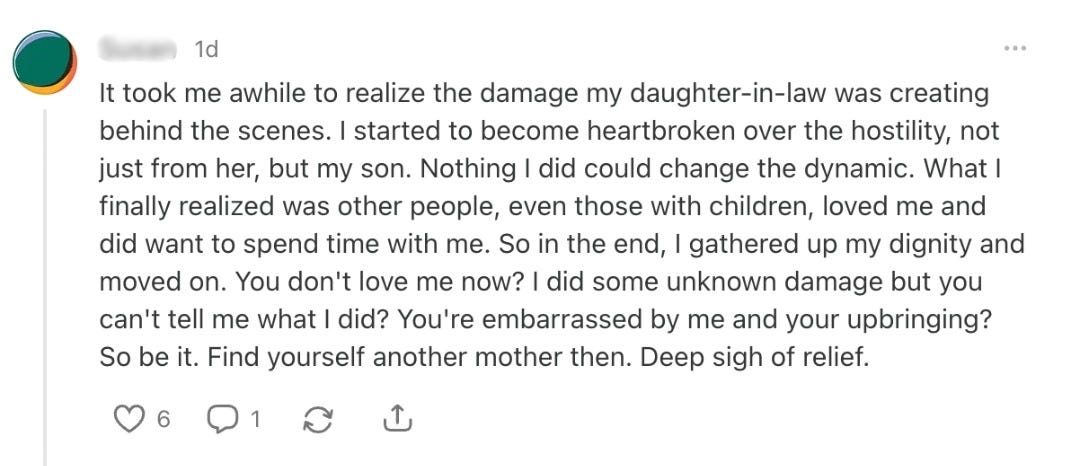
Example 1: Parent as Victim
*Public comment anonymised and included from Substack for educational purposes. This was a publicly posted, unsolicited response.
→ Victim stance: Disempowered, wronged, moral high ground. → Child cast as Persecutor—the one who allegedly caused the harm by setting a boundary.
Example 2: Collapsed Parent as Guilt-Tripping Persecutor
*Public comment anonymised and included from Substack for educational purposes. This was a publicly posted, unsolicited response.
→ Role shift: Victim-turned-Persecutor: Emotional retaliation, guilt-tripping, and passive-aggressive control emerge
Example 3: The Outside Influence Becomes the Villain
*Public comment anonymised and included from Substack for educational purposes. This was a publicly posted, unsolicited response.
→ Therapy, boundaries, or third parties are framed as coercive or manipulative. → The Rescuer (e.g., partner, therapist, ideology) becomes the new Persecutor.
Example 4: Retaliatory Control
*Screenshot anonymised and included for educational purposes, with original comment publicly posted.
→ Persecutor role in full view: Overt punishment, control tactics, financial leverage, and emotional retribution.
These examples don’t mean that every estranged parent behaves this way, or that every adult child who goes No Contact is acting from healthy differentiation. They show something narrower: how quickly people move around the Drama Triangle when an established relational structure breaks down.
When someone stops rescuing, absorbing blame, or performing to be seen, the entire structure has to reorganise. And in systems invested in fusion, denial, or control, that departure is can be experienced as betrayal.
The Role Doesn’t End When You Walk Away
If you have left the Drama Triangle in your family, leaving the relationship doesn’t necessarily end the pattern. The Drama Triangle can become a blueprint for all future relationships. We learn positions early and can continue reproducing them long after the original people are gone.
Many adult children go No Contact and still find that:
The parent who punished you for saying no becomes the partner whose disappointment you cannot tolerate.
The caregiver you had to rescue becomes the employer you chronically over-function for.
The sibling whose emotions you had to manage becomes the friend whose needs always seem to outrank your own.
The people change. The position remains familiar. They’ve left the family, but the blueprint is still running internally.
No Contact Isn’t the Same Thing as Individuation
There is a critical distinction that gets lost in public conversations about family estrangement, which tend to flatten into a black-and-white moral debate: Is going No Contact right or wrong? Is it good or bad?
That question gets us nowhere. It lacks nuance and misses the entire point of why a boundary is set in the first place.
Creating physical distance is merely a relational setup—it is not automatically the internal psychological freedom that individuation seeks.
Individuation is the actual work. It is the process of becoming a separate human being within the relationships and systems we belong to. It means developing enough of your own centre of gravity that your sense of self, your boundaries, and your choices no longer depend entirely on keeping the family system comfortable.
You can stop speaking to your family and remain completely entangled with them internally. You can spend years arguing with them in your head, needing them to understand what happened, waiting for an apology, or organising your life in opposition to them. Physical separation can be necessary, but it doesn’t automatically create psychological separation.
The reverse is also true. Some people individuate while remaining in relationship with their families. They learn to tolerate disapproval. They stop rescuing. They allow other people to be disappointed. They develop boundaries without requiring everybody else to agree with them.
But that is only possible when a family system actually has room for a separate human being inside it.
In high-conflict, coercively controlling, or deeply enmeshed family systems, differentiation isn’t celebrated as growth. It is experienced as an assault on the group, an act of abandonment, or an outright betrayal.
It functions much like trying to claim personhood inside a cult or a high-control group. You aren’t permitted an independent self; your personhood is expected to function purely in service of the collective. The system relies on everyone staying in their assigned Drama Triangle roles to maintain its fragile sense of stability.
And because of basic system dynamics, the moment you stop playing your role, the group feels like it’s falling apart. A system under threat will always try to preserve itself—which means any attempt to step out of your role causes the family to pull you back in with even greater force.
This can show up in small, mundane choices:
Choosing not to answer every phone call the second your screen lights up.
Saying no to coming to Sunday dinner every single week.
Or it can explode around the bigger choices that demand true autonomy:
Pursuing a career that isn’t approved by the family.
Choosing a partner regardless of whether the family likes them.
In the most rigid versions of these systems, a new partner is rarely a welcome addition unless they can be recruited into a pre-existing role within the system. Can they rescue? Fantastic. Will they help rescue the Victim and abide by the system’s rules? Perfect, welcome to the family.
But if they deviate from the script in any way, or if they are seen as influencing the adult child at all, they can quickly become a rival force stealing you away from your assigned role.
A new partner doesn’t just represent another person entering the family. They often offer the adult child something they may never have had before: an external vantage point outside the triangle.
The partner might notice dynamics the adult child has spent a lifetime accepting as normal. They might question behaviour the family has never questioned, or refuse to play roles everyone else has quietly agreed to perform. Through that relationship, the adult child begins to see the system accurately from the outside for the first time.
Now the threat isn’t simply that you’ve found a partner. It’s that you are beginning to stand somewhere else.
And so, the partner is very easily cast as the new Persecutor—the villain who corrupted you, brainwashed you, and destroyed the family.
From a systems theory perspective, this is a new system forming with its own centre of gravity. But a coercively controlling, narcissistically defended system that perceives one of its parts moving into a new system is not going to tolerate it. The old system panics, rejects the shift, and ramps up the pressure to drag you back into line.
This creates a major challenge for couples—which is a whole other conversation, but it helps explain why some conflicts around in-laws are about far more than simple personality clashes. Two family systems may actually be negotiating competing expectations around loyalty, responsibility, and belonging.
When even the most basic day-to-day boundaries are endlessly overrun with guilt-tripping, emotional collapse, punishment, or coercive control, you are presented with a brutal binary: surrender your personhood to keep the peace, or accept the retaliation that comes when you choose yourself—and the new life, partner, or family you are building.
In those environments, going No Contact is not a trendy choice or an attempt to dodge the work of individuation. It is a last resort. It is the family version of walking away from a system that requires your self-erasure as the price of belonging.
When every boundary is endlessly overridden, distance becomes the only boundary the system cannot continually bulldoze. Ending contact in these circumstances creates the only available container where the internal work of becoming yourself can actually begin.
So for me, the deeper and more relevant question isn’t simply: Should someone go No Contact? That’s a useless question.
The real question is:
Can I remain myself in relationship with you? And if I can’t, what does becoming myself require?
When You Understand the Role, but Keep Living It
If you’ve made it this far—whether you’re reading this essay or listening along—take a moment to just let all of this land. I know I’ve dropped a behemoth amount of information on you, and it is a lot to process.
I want you to consider everything I’ve shared here a free course in estranged family dynamics and relational blueprints.
I’m giving this away for free because working with me in long-term psychosomatic consultation is costly—and I know that level of 1:1 work simply isn’t accessible to everyone. I’ve spent nearly two decades of my life trying to figure this out. I have been estranged from my family for years, and my family system is one where distance exists across multiple generations.
Family estrangement rarely begins in a vacuum. Often, when you start looking backwards through a family system, you find earlier versions of the exact same blueprint. Previous generations might not have used the word “estrangement”, but you will often find some version of emotional cut-off, rigid distance, cold compliance, or relationships that simply disappeared without ever being spoken about. A blueprint like this can be passed down silently from generation to generation—until someone finally sees it.
And the first step to changing that blueprint is simply recognising that it exists. When you start looking at the roles everyone is playing—including yourself—you realise something sobering: until you see the pattern, what feels like choice may actually be an automated script.
This isn’t an anti-family manifesto. I am not advocating for hyper-individualism, running away, or cutting everyone off so you can live in a vacuum. This is about discovering how to build family without enmeshment—how to create genuine belonging without requiring the sacrifice of your selfhood.
And if you’re looking around right now and realising that this Drama Triangle doesn’t just live in your family, you’re right. Once you see this pattern, you can’t unsee it. You will see it in your workplace, in your friend groups, in politics, and in the coercive dynamics of broader society. It is one of the ways high-control systems maintain themselves.
Which brings us to the catch: having the map doesn’t get you out of the forest.
You can understand all of this intellectually, memorise every corner of the Drama Triangle, and still find that your nervous system responds exactly as it always has. The moment a boundary is tested, your entire body will still mobilise to fix, appease, blame, or collapse.
Because the triangle isn’t just an idea. Over time, these roles become automatic, somatic ways of responding. Information is free. Actually changing an automatic, system-wide response is something else entirely.
For those who want to take this a step further and move from understanding the pattern to experiencing something different, this is where my practice begins. I don’t coach people on whether they “should” go No Contact. I work with people to develop selfhood and restore agency where there previously felt like very little choice.
This is why I developed the Psychosomatic Restoration Method™ (PSR).
PSR works across three interconnected dimensions:
The Soma: We work with what happens automatically in the body—the nervous-system responses, physical impulses, emotional shifts, and the visceral pull to fix, appease, attack, withdraw, or collapse.
The Psyche: We work with the internal parts of the self that take up these roles, what they’re protecting, what they believe will happen if they stop, and what exists underneath them.
The Relational & Systemic Field: We work with what happens between people and within systems—paying attention to how these roles emerge in relationships (including between practitioner and client) and the larger intergenerational patterns that shaped them.
The point is integration. The pattern moves through the whole person and the systems they belong to, so the work has to meet it there.
You now have the map of the Drama Triangle for free. What you do with your own relational blueprint from here is where choice begins.
If you recognise yourself in this essay, understand the pattern intellectually, but find yourself still living it, this is the work we do in psychosomatic consultation—whether through a single Strategic Deep Dive or ongoing 1:1 work.
Tanya Master is a psychosomatic consultant and developer of the Psychosomatic Restoration Method™. Her work explores the gap between what we understand about ourselves and the patterns our bodies and relationships continue to repeat. She works online with clients internationally.
“Stepping out of the triangle isn’t just about distance or disconnection. It’s not simply setting a boundary or shutting a door. It’s an internal departure. A symbolic reorganisation. A structural shift that must be integrated across every level of your system: body, mind, lineage, psyche, and self.”
And so the work begins - life beyond what I call ‘the trauma vortex'.
For me, stepping out took years, but ultimately was a refusal to collude with a system of abuse, and the associated self-negation it demanded.
As always, you provide an interesting explanation of a concept: the drama triangle. I do try to see things from various perspectives. As you mention in your essay, these roles of Victim, Rescuer, and Persecutor can cycle. I am reflecting on a different take, one in which the adult child sees themselves as victim. Let’s say for example that one parent is labeled as persecutor and the other parent is labeled as rescuer. The child may end the relationship with both parents once a new rescuer has been identified (for example, a new partner in the adult child’s life). The person labeled as persecutor is removed from the AC’s life, and the old rescuer is no longer needed on two levels- the current persecutor has been eliminated (so no need for rescue); and a new rescuer has been found who will replace the role of the rescuer parent in the face of any future persecutors. The AC may have eliminated a particular drama triangle by cutting off the parents. But just as in the case of a parent who believes they are a victim, the victimhood doesn’t end because a triangle has been eliminated.
The drama triangle seems like it would be a very helpful tool in family therapy. There is, at the same time, a risk of framing all group relationships involving 3 or more people in terms of victims, rescuers, and persecutors. Eliminating these dynamics by moving on to other relationships may or may not eliminate the drama. New relationships will undoubtedly put the AC into contact with people who are have a victim mentality, or people whom the AC may desire to rescue, or people who are bullies, or people who are victims of bullying. As we can’t control the mindsets or life circumstances of other people, I am not sure we can ever truly escape from drama triangles without eliminating people from our lives on a regular basis.
I suppose the best defense is for all of us to bolster our own self worth, clarify our values, improve our communication skills, and our ability to honestly self-evaluate our actions and motives.







“Stepping out of the triangle isn’t just about distance or disconnection. It’s not simply setting a boundary or shutting a door. It’s an internal departure. A symbolic reorganisation. A structural shift that must be integrated across every level of your system: body, mind, lineage, psyche, and self.”
And so the work begins - life beyond what I call ‘the trauma vortex'.
For me, stepping out took years, but ultimately was a refusal to collude with a system of abuse, and the associated self-negation it demanded.
Brilliant article, Tanja.
As always, you provide an interesting explanation of a concept: the drama triangle. I do try to see things from various perspectives. As you mention in your essay, these roles of Victim, Rescuer, and Persecutor can cycle. I am reflecting on a different take, one in which the adult child sees themselves as victim. Let’s say for example that one parent is labeled as persecutor and the other parent is labeled as rescuer. The child may end the relationship with both parents once a new rescuer has been identified (for example, a new partner in the adult child’s life). The person labeled as persecutor is removed from the AC’s life, and the old rescuer is no longer needed on two levels- the current persecutor has been eliminated (so no need for rescue); and a new rescuer has been found who will replace the role of the rescuer parent in the face of any future persecutors. The AC may have eliminated a particular drama triangle by cutting off the parents. But just as in the case of a parent who believes they are a victim, the victimhood doesn’t end because a triangle has been eliminated.
The drama triangle seems like it would be a very helpful tool in family therapy. There is, at the same time, a risk of framing all group relationships involving 3 or more people in terms of victims, rescuers, and persecutors. Eliminating these dynamics by moving on to other relationships may or may not eliminate the drama. New relationships will undoubtedly put the AC into contact with people who are have a victim mentality, or people whom the AC may desire to rescue, or people who are bullies, or people who are victims of bullying. As we can’t control the mindsets or life circumstances of other people, I am not sure we can ever truly escape from drama triangles without eliminating people from our lives on a regular basis.
I suppose the best defense is for all of us to bolster our own self worth, clarify our values, improve our communication skills, and our ability to honestly self-evaluate our actions and motives.